It's OP_RETURN on Bitcoin, but It Isn't Runes. It's Alkanes.
The Bitcoin transaction surge everyone is citing is real. The cause they keep naming is out of date.
The headline everyone repeated
In June 2026 a striking statistic made the rounds. CryptoQuant reported that micro-transactions, the ones moving less than 0.01 BTC, had grown to roughly 80% of all daily Bitcoin transactions, up from under 50% in 2023. Bitcoin's on-chain activity had pushed above trend for the first time since mid-2024 and kept climbing, even as the price stalled.
Coin Bureau put it to its audience in one line: micro-transactions are taking over Bitcoin.
The number is real. The reporting that followed reached for the obvious explanation, the same one the market has leaned on for two years: Runes, Ordinals, inscriptions, data stamping.
That part is where the story goes wrong.
The measurement is correct. The label on it is out of date.
We decoded the bytes
CryptoQuant measured something true: a flood of transactions carrying OP_RETURN data. OP_RETURN is the small slot in a Bitcoin transaction where protocols write their payload. To know which protocol is responsible, you have to decode what is written there.
An independent researcher did exactly that. Renaud Cuny, who publishes Bitcoin Block Space Weekly and has been openly skeptical of metaprotocols, decoded every OP_RETURN output over a 60-day window. He went looking for Runes. Here is what the bytes said:
91% of all OP_RETURN outputs on Bitcoin are Alkanes. Runes has collapsed to under 2%.
Not for a few days. The Alkanes share held between 95% and 98% every day for three straight weeks. Over the same window, OP_RETURN traffic grew from roughly 13% to roughly 34% of Bitcoin's block space, and the transactions carrying it consumed close to 39% of everything the chain produced. In his own words, this is "a steady state, not a mania."
So the surge is real, and it has a name: Alkanes. The name is not the one in the headlines.
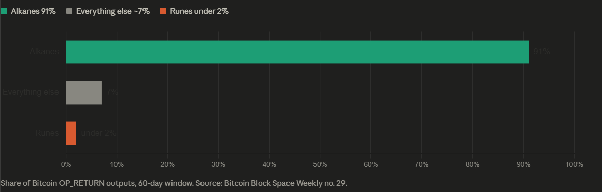
Figure 1. Share of Bitcoin OP_RETURN outputs, 60-day window: Alkanes 91%, everything else about 7%, Runes under 2%. Source: Bitcoin Block Space Weekly no. 29.
Why every dashboard still says Runes
It is not carelessness. The tools themselves are behind.
Take the OP_RETURN report published by mempool.space research, one of the most trusted sources in Bitcoin. It classifies OP_RETURN traffic by matching known protocol prefixes, and it tracks around twenty of them. It has no classifier for Alkanes. So it reports, in good faith, that almost all recent OP_RETURN activity is Runes, with data dated to early 2026, before the shift became obvious.
There is a deeper reason the misread is so easy to make. Alkanes rides inside a Runes-compatible envelope. Its calldata rides inside a Runestone, Runes' own OP_RETURN message. It travels there as a protostone, a protorunes structure flattened into a dedicated tag within that Runestone. The protocol filling the blocks is, to most off-the-shelf tooling, invisible.
CryptoQuant flagged the surge as OP_RETURN-driven, which is exactly right. The popular read then filled in "Runes and Ordinals," which is exactly the part the bytes no longer support.
Alkanes is the most-used thing on Bitcoin that your dashboard cannot see.
What you are actually looking at
If 91% of the OP_RETURN surface is one protocol, it is worth knowing what it does, because "millions of tiny transactions" sounds like spam, and it is not.
Alkanes is a smart-contract metaprotocol on Bitcoin. It runs on a factory model: a contract's code is deployed once, and from then on everyone interacts with it through small, cheap messages. Of roughly 19-million Alkanes messages in the measurement window, the share that deployed new code was a rounding error. The other 99.99% were people using what already exists: mints, transfers, swaps, contract calls. That is not noise on the chain. That is demand.
It also does not bloat Bitcoin. When inscriptions arrived in 2023 they parked data in the UTXO set and left a permanent mark, the kind of thing that makes node operators rightly nervous. Alkanes is the opposite shape of load. Around 99% of its carriers are ordinary self-spends that get created and respent, a large flow that leaves almost no lasting footprint.
The honest part
There is one caveat worth stating plainly, because precision is the point here. Rank protocols by total fees paid over their entire lifetime, and Runes and BRC-20 still sit ahead of Alkanes. They had a long head start. But lifetime totals describe the past.
The quiet part
Step back and the picture is strange. By on-chain activity, Alkanes is the most-used thing on Bitcoin today. By Western mindshare, it barely registers. And the gap is widening at the exact moment the BTC price looks boring.
CryptoQuant's own observation is that activity is running near its highs while the price stalls. Usage at multi-year highs against a flat price is not a speculative mania. It is people using a system because it does something for them.
That something is what SUBFROST builds on top of Alkanes: frBTC, synthetic Bitcoin you can mint in a single Bitcoin transaction, plus swaps and yield, all happening atomically and settled on Bitcoin L1. The rails are live. The usage is a steady state. The only thing missing is the West looking up.
Bitcoin-native yield, done right.
The meter is right. The legend is wrong. And the protocol it keeps leaving off the label is the one writing most of what Bitcoin now records: Alkanes.
Sources: CryptoQuant network activity research, June 2026 (via The Block and FXStreet) for the micro-transaction and activity figures; Bitcoin Block Space Weekly no. 29, "Counting the Leaves" (Renaud Cuny), for the OP_RETURN decode; mempool.space research OP_RETURN report for protocol classification; Bitcoin Core v30 release notes for the OP_RETURN limit change. Figures reflect a 60-day window ending June 2026.